
Message from the President – Douglas Zochodne
Dear CAN colleagues,

It is my pleasure to provide you with an update on CAN’s recent activities and opportunities for our members.
First, I would like to invite you all to register for the upcoming CAN meeting which will take place May 18-21, 2026 in Montreal at the Bonaventure Hotel. The program chairs Rose Bagot and Mark Cembrowski have put together an excellent scientific program – Please check it out and join us ! Regular registration rates apply until April 29, 2026.
A special note to parents, family caregivers and people who may require a travel companion: we are happy to announce that the Canadian Association for Neuroscience Conference Childcare, Dependent, or Disability Care Subsidy program is continuing for a third year. Applications for this program are still open. See all the details below.
We are also pleased to highlight in this newsletter the various satellite meetings that will take place before the main CAN meeting. Official satellite meetings are CAN member organized events that complement the main program and offer special interest groups the opportunity to meet and network with experts in their specific fields. You can view this year’s varied satellites below. Note that you need to register separately for these events.
Advocacy remains one of CAN most important missions, and we are pleased to announce our next Parliament Hill Day will take place April 14, 2026 in Ottawa. We have a team of 16 ‘Neuroadvocates’ from across Canada ready to meet Members of Parliament, Senators, staff members and other key decision makers in Ottawa to highlight the importance of scientific research in Canada and the need for more sustainable funding.
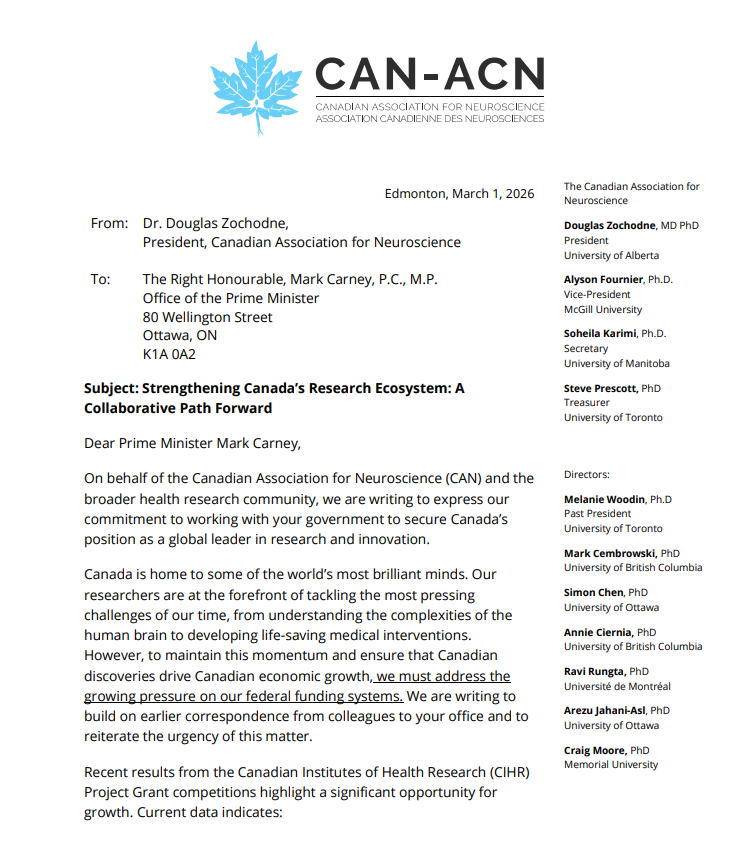
I also invite you to read the letter we wrote to Prime Minister Mark Carney to emphasize the importance of properly funding CIHR and specifically highlighting how the low CIHR project grant success rates are damaging and require repair. Read the full letter here: https://can-acn.org/read-our-letter-to-prime-minister-mark-carney/. Please continue your individual advocacy by being in touch with your own members of Parliament and educating the public on the importance of research.
I look forward to seeing you all at the CAN meeting in Montreal this spring. At the meeting I will hand the torch (hockey stick and puck) over to our incoming President Dr. Alyson Fournier who will do a wonderful job in carrying the flame, along with our outstanding Chief Operating & Advocacy Officer, Julie Poupart. For my part, its been an honour and privilege to work with CAN and all of you. Please keep up the great work and continue to vigorously advocate for support and progress in Neuroscience, fundamental and clinical.
Thank you for reading our newsletter, and for being engaged members of our community.
Douglas Zochodne, President of the Canadian Association for Neuroscience
CAN Board of Directors – Call for nominations now open
CAN will be holding elections for the following Board of Direction positions:
- Vice-President (President elect)
- Secretary-elect
- 2 board members
We are now sending a call for nominations for these positions. Please note that only members in good standing can submit nominations.
To submit a nomination, we invite you to reach out to potential candidate that are representatives of the strength and diversity of our community. We also aim to have geographical representation from across Canada.
View current members of the CAN Board of Directors
Nomination deadline is: April 16, 2026
Documents required:
- CV (any pdf format – a link will be shared on the candidate profile page)
- Nomination letter from a CAN member
- Picture (headshot) for the candidate presentation page
- Short text (max. 250 words) for the candidate presentation page (motivation, qualification).
Visit this webpage to submit a nomination:
Advocacy updates
Read our letter to Prime Minister Carney
CAN President Douglas Zochodne sent a letter on behalf of CAN to Prime Minister Mark Carney on Neuroscience research and CIHR Project Grant Operations shortfalls.
Here is an excerpt:
We believe that a strategic, predictable increase in research investment, particularly in
Project Operating Grants, will yield high returns for Canada by:
- Retaining Talent: Preventing the “brain drain” of our best and brightest to countries
with more robust funding. - Driving the Economy: Turning basic discovery into the biotechnology and health
care industries of tomorrow. - Improving Health Outcomes: Directly translating lab breakthroughs into better care
for Canadians.
Canada has an opportunity to support research in areas of expertise where our leadership
is recognised across the globe. Brain research is one area in which Canada shines
particularly brightly
Click to read the full letter here
Next CAN Parliament Hill Day: April 14, 2026
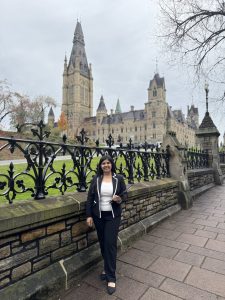
We are excited to announce our next Parliament Hill day will take place on April 14, 2026. We will be traveling to Ottawa with a group of 16 neuroadvocates from across the country to advocate for increase support for health and brain research in Canada.
Follow us on social media to see our team in action!
CAN Meeting updates

19th Canadian Neuroscience Meeting
May 18-21, 2026 | Montréal | Hotel Bonaventure
Join us for the 2026 Canadian Neuroscience meeting in Montreal, May 18-21, 2026. The Canadian Neuroscience meeting is a great opportunity to present your work, learn about new cutting-edge research and network with neuroscience leaders from Canada and abroad.
The chairs of this year’s meeting, Drs. Rosemary Bagot and Mark Cembrowski are putting together an exciting program that covers a wide range of neuroscience topics. Meeting local chair Dr. Stuart Trenholm has a great lineup for the 2026 public lectures.
Save the dates!
- Dates: May 18-21, 2026
- Location: Hotel Bonaventure Montréal
- Sponsor: McGill University Faculty of Science
- Organizers:
- Rosemary Bagot, Chair of the Scientific Program Committee,
- Mark Cembrowski, Co-Chair of the Scientific Program Committee
- Stuart Trenholm, Chair of the local organizing committee
Scientific program
View the program, including the full list of plenary and parallel speakers and symposia here:
Speakers at the 2026 public lectures: Je me souviens: Montréal, the city of memory
Date & Time: May 17, 5PM – 7PM
Location: Jeanne Timmins Auditorium, The Neuro – McGill University
Webpage: https://can-acn.org/meeting-2026/public-lectures-je-me-souviens-montreal-the-memory-city/
Speakers
Eric Andrew-Gee
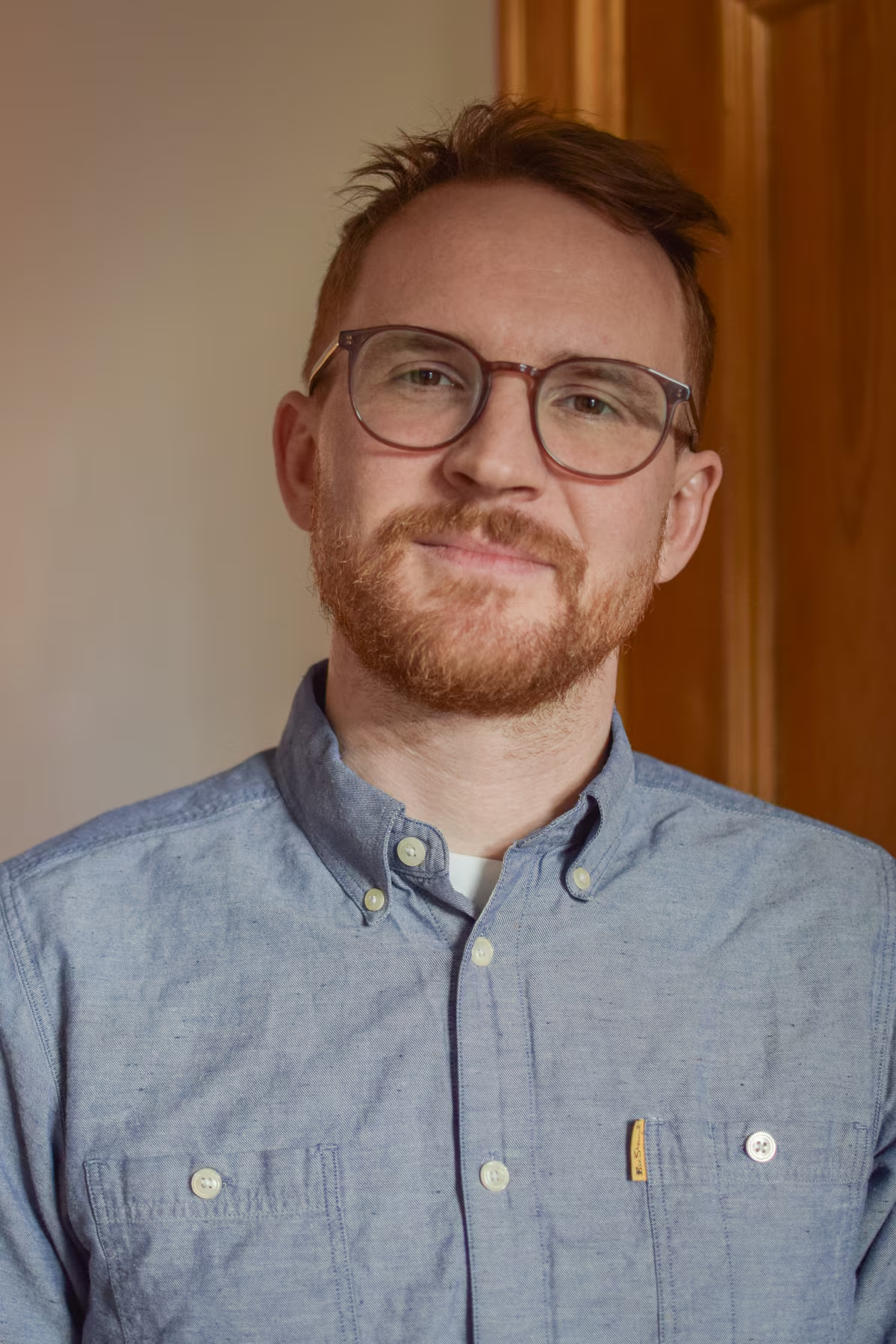
Eric Andrew-Gee is a correspondent in the Globe and Mail’s Quebec bureau. The Mind Mappers, his bestselling history of the Montreal Neurological Institute and its founding partners, was published in May 2025 and awarded the Quebec Writers’ Federation First Book Prize. He lives in Montreal with his wife and twin toddlers.
Talk title: Of Two Minds: The Brilliant, Tragic Friendship That Invented Montreal Neuroscience
Mihaela Iordanova
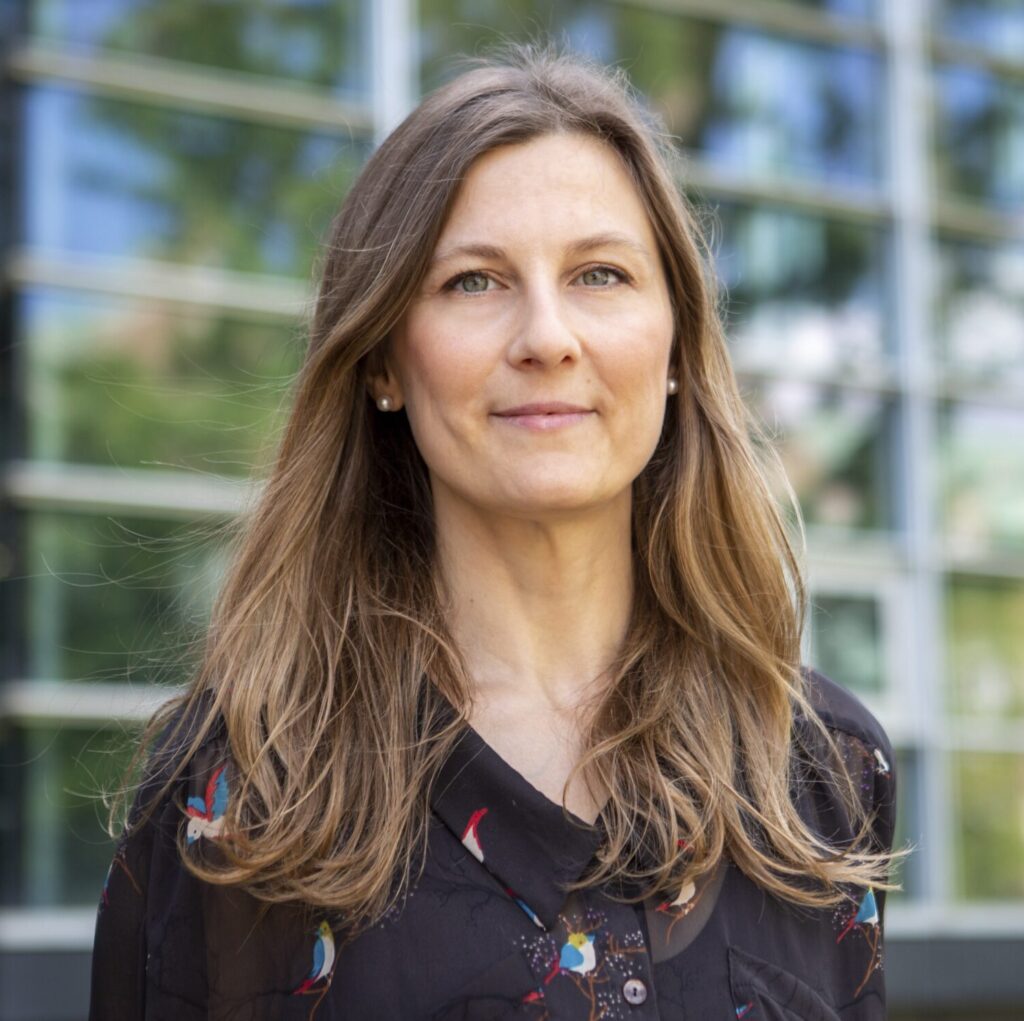
Dr. Mihaela Iordanova is Professor at Concordia University, a Canada Research Chair (Tier 2) in Behavioural Neuroscience, co-director of the Centre for Studies in Behavioral Neurobiology and Deputy Editor-in-Chief of eNeuro. She obtained her PhD from the University of New South Wales, Sydney, Australia. Her research focuses on elucidating the behavioural and neurobiological mechanisms underlying fear and reward learning, and their interaction, using an integrative approach that combines neural recording, circuit interrogation, computational modelling, and behavioural analysis. In 2020 she won the Canadian Association for Neuroscience Young Investigator Award, and in 2023 the Pavlovian Society Research Award. She is president-elect of the Pavlovian Society and was recently elected as vice-chair of the Amygdala Gordon Research Conference.
Talk title: Memory Across Eras: From Intervention to Imagination

Blake Richards
Blake Richards is Research Scientist with the Paradigms of Intelligence team at Google, and an Associate Professor in the School of Computer Science and Department of Neurology and Neurosurgery at McGill University. He is also a Core Faculty Member at Mila, The Quebec AI Institute, where he holds a CIFAR AI Chair. Richards received the CAN Young Investigator Award in 2019 and the NSERC Arthur B. McDonald Fellowship in 2022.
Talk title: Why AI needs literal synapses
Many thanks to the event sponsors:
- The Neuro
- McGill Faculty of Science
Hotel accommodation
The CAN-ACN Meeting hotel, the Hotel Bonaventure Montréal is now open for booking.
Booking your room at the meeting venue allows you to:
- be present at the venue without commute for early morning sessions
- take advantage of the preferential rates we have negotiated
- be present for many informal networking opportunities at breakfast and meals
- helps CAN financially as each room booked by meeting attendees counts towards keeping costs down
Reserve your room today!
Please ensure that all reservations are made on or before the cutoff date of April 29, 2026. After this date the preferred rates are not guaranteed and may substantially increase. Please remember to reserve your hotel room(s) before the deadline as the CAN room block will not be extended beyond this point. There are a fixed number of rooms available to our group, so please reserve your room early to avoid disappointment.
Dependent care subsidies
CAN is proud to offer Conference Childcare, Dependent, or Disability Care Subsidies for the second year. Funding under this program is intended to benefit Canadian Association for Neuroscience trainee members, postdoctoral fellows, and pre-tenure faculty (or equivalent) who attend the Canadian Association for Neuroscience conference by helping to alleviate the financial burdens of childcare or adult dependent care while attending the meeting for oral or poster presentations. Members who require a travel companion due to their own disability are also eligible for the subsidy.
CAN Satellites and partner sessions
CAN2026 Official Satellite Meetings
Satellites are independently organized events
Satellite 1: Circuits and Behaviour CAN 2026 Satellite Meeting
- Organizers: Mark Cembrowski and Paul Frankland
- Date & Time: May 18th, 2026 – 9AM – 4 PM
- Venue: Hotel Bonaventure
- Info & Registration link: https://www.eventbrite.ca/e/neural-circuits-and-behaviour-can-2026-satellite-meeting-tickets-1984146883741
Satellite 2: Brain Canada Future Leaders in Canadian Brain Research Knowledge Exchange Event

- Organizer: Kate Shingler – Brain Canada
- Date & Time: May 18, 2026 – 1PM – 4PM
- Venue: Hotel Bonaventure
- Info & Registration: Contact Kate Shingler via email kate.shingler at braincanada.ca – More information here: Satellite 2: Brain Canada Future Leaders in Canadian Brain Research Knowledge Exchange Event – Canadian Association for Neuroscience
Satellite 3: 11th Annual Canadian Neurometabolic meeting
- Organizer: Stephanie Fulton
- Date & Time: May 18, 2026
- Location: Hotel Bonaventure
- FREE ABSTRACT SUBMISSION AND REGISTRATION HERE
The Canadian Neurometabolic meeting, a satellite of the Canadian Association for Neuroscience, is a unique event that brings together scientists studying CNS controls of energy balance, neural cell metabolism, the impact of metabolism on brain and behavior, and the interaction between metabolism and brain disorders. A primary goal of this meeting is to provide a valuable platform for trainees to share their latest findings and network.
Satellite 4: Tracking social determinants of health (SDoH) in neuroimaging across the lifespan: A Healthy Brains, Healthy Lives (HBHL) Knowledge Exchange Event
- Organizers: Anna MacKinnon (University of Montreal) & Tasmia Hai (University of Manitoba)
- Date & Time: May 18, 2026 – 9 AM to noon
- Location: Hotel Bonaventure
- Ticket price: Registration is free but required
- Registration: https://forms.office.com/Pages/ResponsePage.aspx?id=cZYxzedSaEqvqfz4-J8J6jkeHi0J2uVEtnrBYB8RxNpUNUJYMEJQUjE3N1E0OVlWMEJZOThGOTNSTyQlQCN0PWcu
This integrated knowledge exchange event will bring together researchers, clinicians, and trainees to advance the inclusion of social determinants of health (SDoH) in neuroscience.
Satellite 5: Cells in Space: A Hands-On Journey Through Spatial Transcriptomics
- Organizer: Shalini Iyer, University of British Columbia
- Date & Time: May 18, 2026 – 9AM – 4PM
- Location: Montreal Neurological Institute, McGill University
- Registration: https://ubc.ca1.qualtrics.com/jfe/form/SV_a9IqB75UKvK7pwG
- More information: Satellite 5: Cells in Space: A Hands-On Journey Through Spatial Transcriptomics – Canadian Association for Neuroscience
Satellite 6: Stem Cells and Brain Development
- Organisers : Armen Saghatelyan (University of Ottawa), Karun Singh (Krembil Research Institute) & David Kaplan (SickKids)
- Date & Time: May 18, 2026 – Full day
- Location: Hotel Bonaventure
- Registration: https://www.eventbrite.ca/e/stem-cells-and-brain-development-tickets-1982633808091
The 8th Satellite Meeting on Neural Stem Cells (NSCs) and Neural Development will bring together experts and trainees to share ideas and discuss recent advances in embryonic and postnatal stem cells, synaptogenesis, and neurodevelopmental disorders. Speakers from institutions across Canada and at all career stages will present new findings on how neural development proceeds under normal conditions and how its disruption leads to disease.
Satellite 7: COVF workshop on genetically encoded sensor development and applications
- Organizer: Marie-Ève Paquet
- Date & Time: May 16, 2026 – half day
- Location: The Neuro
- Registration: https://forms.gle/1WAHEoBSnA2iMEj39
- More information & speaker list: Satellite 7: COVF workshop on genetically encoded sensor development and applications – Canadian Association for Neuroscience
Event organized by the Canadian Optogenetics and Vectorology Foundry (COVF). Overview of the field of genetically encoded fluorescent sensors with historical perspectives followed by workshops that include practical considerations in design, screening and applications of these tools for neuroscience. There will also be a discussion on the ethical and regulatory aspects surrounding the potential use of optogenetics tools in humans.
Satellite 8: Canadian Symposium on the Neural Control of Breathing
- Organizer: Gaspard Montandon
- Date & Time: May 17, 2026 – Full Day
- Location: Reine Elizabeth Fairmount Hotel – Rue-Saint-Paul Room
- Registration: https://www.eventbrite.ca/e/1984990294405
- More information & speaker list: Satellite 8: Canadian Symposium on the Neural Control of Breathing – Canadian Association for Neuroscience
Description:
This satellite symposium will bring together researchers and trainees who are investigating the neural circuits and physiological mechanisms underlying breathing. This symposium brings together teams from institutions across Canada covering a wide-range of topics and diseases related to autonomic nervous functions, such as sleep-disordered breathing, opioid-induced respiratory depression, cardiovascular and metabolic dysfunctions leading to abnormal breathing.
Satellite 9: Integrate and Fire Satellite Symposium
- Organizers: Zeeshan Haqqee, Lucia Pizzoccaro, Peter Fleming, Wanyi Lyu
- Location: Université de Montréal – Campus MIL (Complexe des Sciences)
- Date/Time: Monday May 18th – Full day
- Ticket price: now only $5
- Registration Link: https://event.fourwaves.com/integrateandfire2026/
- Website: https://www.integrateandfire.com/can2026
Brief Description
***Speaker Abstract Deadline April 6***
Academic research has become increasingly specialized, narrowing trainee perspectives toward the small circles equipped to understand their work. Yet major scientific problems are inherently interdisciplinary. At conferences, we tend to remain in familiar bubbles, attending talks by the same groups, networking with people we already know, while connections that could reshape our thinking go unmade.
The Integrate and Fire Satellite Symposium offers a full-day, trainee-centered event designed to foster genuine interdisciplinary connections among early-career neuroscientists before the main CAN 2026 conference. Participants present their work within thematic sessions organized around big, shared questions in neuroscience, with guided extended discussions that focus each session on genuine dialogue. The event includes an algorithmic speed networking session designed around participants’ research abstracts and clustered poster sessions to provide additional structured opportunities for meaningful connections. We aim to provide attendees with an established network of peers going into the main CAN conference, ready to continue their conversations and expand into each other’s circles throughout the week. Lunch and coffee provided.
Save the dates for these special events at the CAN meeting
Save the date: IBRO – NCAMH Special Interest Event: Building Capacity and Community in Global Neuroscience
Organiser: International Brain Research Organization (IBRO)
Funder: Wellcome
Date & Time: Wednesday, 20 May 2026; 19:00 – 20:00
Location: Room Montreal 6-7-8 @ Bonaventure Hotel
This Special Interest Event (SiE) is organized within the framework of the Neuroscience Capacity Accelerator for Mental Health (NCAMH), an innovative program supporting neuroscience research capacity in Low- and Middle-Income Countries (LMICs). Following the scheduled EDI session, the event aims to elevate lived experience perspectives in mental health research and highlight the value of international collaboration.
Speakers
- Emma Byrne, PhD | Robot Scientist, Neuroscience Author
- Andreea Dioconescu, PhD | NCAMH Project Collaborator
- Julie Lefebvre, PhD | Former NCAMH Scientific Advisory Board Member
CIHR Canadian National Brain Bee Showdown
The Canadian National Brain Bee is a neuroscience competition for high school students, grades 9 through 12. Students study brain and neuroscience research topics including memory, sleep, intelligence, emotion, perception, stress, aging, brain imaging, neurology, neurotransmitters, genetics, brain disease, and more. It is organized by the Canadian Brain Bee team, led by
CAN is excited to host the CIHR Canadian National Brain Bee Showdown again this year at the CAN meeting. The top 3 competitors from the first phase won travel and accommodation to compete in the second phase of the Canadian National: the Final Showdown, which will be held in person at the 2026 Canadian Association for Neurosciences annual meeting in Montreal on May 20th, 2026 from 12:00 – 1:30 PM.
Learn more about the Brain Bee here: https://brainbee.ca/
Women in Learning Luncheon at CAN
Organized by: Women in Learning https://www.womeninlearning.com/
Event Purpose: To bring together voices in neuroscience, this luncheon provides an opportunity to network, share experiences, and foster mentorship within the neuroscience community. It is designed to create a supportive environment that encourages professional growth and collaboration. Our guided discussion will facilitate open dialogue and promote knowledge sharing across career stages.
Target Audience: This event is open to all. We encourage anyone who would like to participate in inclusive discussions about building supportive networks, sharing experiences, and navigating professional challenges to attend. Graduate students, postdocs, RAs, and investigators are all welcome regardless of gender identity.
Time: Wednesday, May 20th, 12:00 PM – 2:00 PM
Pre-RSVP Form: To help us plan the luncheon and accommodate all attendees, please fill out this quick form: https://forms.gle/vVXA63iYmfiFZDnf6
Opportunities and Resources
SfN Awards and Prizes – nomination period for most awards opening March 23, 2026
SfN welcomes nominations of a wide range of award candidates. Your nominations help better recognize research achievements made throughout the global neuroscience community. Nominations are opening soon for awards in the following categories
- Outstanding Career and Research Achievements Awards
- Early Career Awards
- Promotion of Women in Neuroscience Awards
- Science Education and Outreach Awards
Please visit the SfN website for more information about all award opportunities from SfN : Society for Neuroscience – Awards
Long-term potentiation: 50 years on – available online in open acccess
The following issue from Royal Society Publishing is now FREE TO ACCESS ONLINE and is one of our most widely read issues: Philosophical Transactions B: Long-term potentiation: 50 years on organised and edited by Wickliffe C Abraham, Timothy V P Bliss, Graham L Collingridge and Richard G M Morris and the articles are FREE to access at www.bit.ly/PTB1906
ALBA Database of scientists with disabilities launched in January 2026
The ALBA Disability & Accessibility Working Group is creating a database to enhance representation, opportunities, and influence for disabled researchers. By joining, you can provide advice on accessibility-related initiatives, serve as a speaker or expert for conferences and workshops, or help improve policies and practices for inclusion in neuroscience.
Don’t miss this opportunity to make a difference — sign up here: https://www.alba.network/database-disabilities
Neurojobs
Recent advertisements posted on our website. See https://can-acn.org/neurojobs/ for more
- 2026-03-11 Canada Impact+ Research Chair (CI+RC) in Sensory Health Transformation – Université Laval
- 2026-03-10 Department of Psychology – Tenure Track Appointment (Neuroscience) – St. Francis Xavier University
- 2026-03-02 Assistant Professor – Behavioural Neuroscience – Wilfrid Laurier University
- 2026-02-05 PhD Proposal Biomedical Sciences, Université du Québec à Trois-Rivières, Québec
- 2026-02-02 Instructor 1 – University of Manitoba
- 2026-01-17 Multimodal Sensorimotor Plasticity: Vision, Neurophysiology, and Behavior – Graduate student position, Université de Montréal
- 2026-01-07 Postdoctoral fellow or PhD student position with Dr. Anastassia Voronova (University of Alberta, Canada)
Thank you for reading our newsletter!