The Canadian Association for Neuroscience held its 2026 Parliament Hill Day on April 14, 2026. It was an opportunity for Canadian neuroscientists to highlight the important work they do for Canada and the importance of government support for Canadian Research.
The meetings
In total, CAN had 19 meetings, including
- 14 parliamentarians (2 Senators and 12 MPs including 2 parliamentary secretaries),
- 8+ bureaucrats across four departments


CAN participants
We are grateful to the very engaged neuroadvocates who participated in this year’s Hill Day
- Alfonso Abizaid | Carleton University
- Andrew Thompson | The University of British Columbia
- Angelo Iulianella | Dalhousie University
- Ciaran Murphy Royal | Université de Montreal
- Derek Bowie | McGill University
- Douglas Zochodne | University of Alberta
- Jarrad Perron | University of Manitoba
- Julie Poupart | CAN
- Katalin Toth | U. Ottawa
- Seniha Derya Sargin | University of Calgary
- Shalina Sheryl Ousman | Hotchkiss Brain Institute, University of Calgary
- Susanne Schmid | University of Western Ontario
- Tabrez Jamal Siddiqui | University of Manitoba
- Tamara Franklin | Dalhousie University
- Vina Li | Queen’s University
- Zahraa Chorghay | University of Toronto
Our message
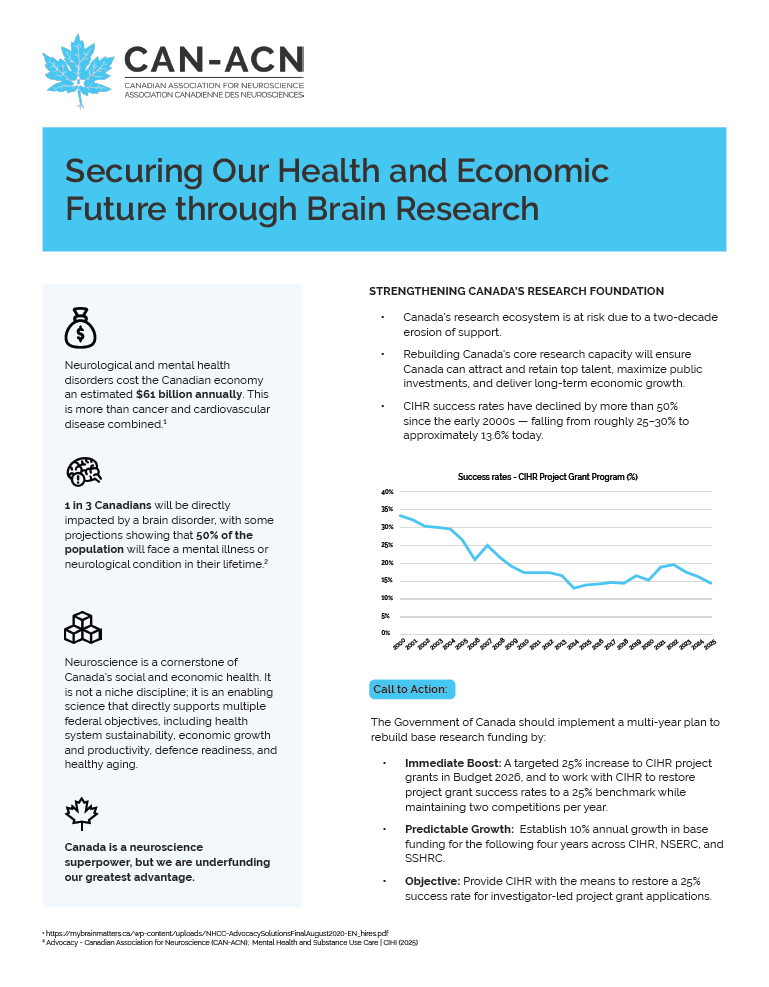
You can download our one-pager here
We highlighted the importance of strengthening Canada’s research foundation
- Canada’s research ecosystem is at risk due to a two-decade erosion of support.
- Rebuilding Canada’s core research capacity will ensure Canada can attract and retain top talent, maximize public investments, and deliver long-term economic growth.
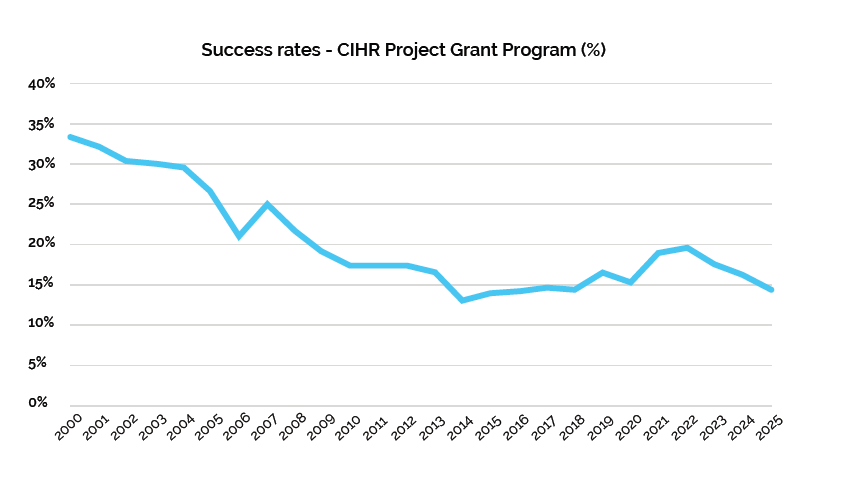
- CIHR success rates have declined by more than 50% since the early 2000s — falling from roughly 25–30% to approximately 13.6% today.
Calls to Action
The Government of Canada should implement a multi-year plan to rebuild base research funding by:
- Immediate Boost: A targeted 25% increase to CIHR project grants in Budget 2026, and to work with CIHR to restore project grant success rates to a 25% benchmark while maintaining two competitions per year.
- Predictable Growth: Establish 10% annual growth in base funding for the following four years across CIHR, NSERC, and SSHRC.
- Objective: Provide CIHR with the means to restore a 25% success rate for investigator-led project grant applications.
Neuroscience must be a central focus as the government develops the new federal capstone research funding organization. By making brain research a central priority, Canada can better utilize its existing leadership to tackle the increasing impact of neurological and mental health conditions
Neuroscience is foundational to federal priorities beyond core research funding. Embedding neuroscience expertise across government strategies will ensure evidence-based policy development and improve outcomes for Canadians. These include Economic Growth, Artificial Intelligence, National Resilience, Defence, Public Safety and Health System Sustainability