
2025-02-06 12:00 – 2025-02-06 13:00
CNS-PDS February: Björn Jörges & Roberto Budzinski
2025-02-06 @ 12:00 – 13:00
Speaker #1
Björn Jörges, York University
Title of the presentation:
Where are you Moving? Assessing Precision, Accuracy, and Temporal Dynamics in Multisensory Heading Perception Using Continuous Psychophysic
Bio:
Björn is currently a Postdoc at York University, Toronto, working in visuo-vestibular multisensory integration and predictive processing. He uses an interdisciplinary approach that combines behavioral tasks administered predominantly in VR and computational modelling to address the impact of online vestibular cues as well as vestibular priors on visual tasks like the estimation of time-to-contact, self-motion, or depth. He is an early adopter and advocate for Open Science practices and proud and vocal member of the LGBTIQA+ community. Most recently he has been excited about a novel paradigm from vision science called “Continuous Psychophysics”, which couples continuous stimulation and continuous participant responses. This paradigm allows to collect large amounts of data in short amounts of time and with uncharacteristically low amounts of participant suffering.
@bjorges.bsky.social
Speaker #2
Roberto Budzinski, Western University,
Title of the presentation:
Predicting traveling waves: a new mathematical technique to link the structure of a network to the specific patterns of neural activity
Roberto is a physicist by training, working at the intersection of network theory, computational neuroscience, and AI. He earned his PhD in Physics from the Federal University of Paraná, Brazil, in 2021. After that, he moved to Canada to join Lyle Muller’s lab at Western University, where he is currently a postdoctoral researcher at both Western University and the Fields Institute. His research focuses on understanding the relationship between the connectivity patterns in a network and the resulting dynamics. Recently, he developed a new mathematical approach that shows the importance of structural connectivity and time delays in generating specific traveling waves in brain networks. More broadly, he is interested in studying spatiotemporal dynamics in neural systems and exploring their potential computational role.
X : @budzinski_r
https://zoom.us/webinar/register/3217374850132/WN_Judvgbe9T6-z8k6xoNIr7A
https://zoom.us/webinar/register/3217374850132/WN_Judvgbe9T6-z8k6xoNIr7A
Canadian neuroscience post-docs
seminars@can-acn.org
2025-03-06 12:00 – 2025-03-06 13:00
Canadian Neuroscience Seminars – Post-doc series March 6 Wendy Xin & Georgina Craig
2025-03-06 @ 12:00 – 13:00
9.00-10.00 Pacific time, 12.00 -13.00 EST, 13.30 -14-30 NST
Speaker #1
Wendy Xin, University of California San Francisco
Title: Regulation of cortical circuit maturation and plasticity by oligodendrocytes and myelin
Bio: She obtained a BSc at the University of Toronto and a PhD in Neuroscience at the Johns Hopkins University School of Medicine. Her current research focuses on the influence of oligodendrocytes and their myelin sheaths on neuronal circuit function and plasticity. Wendy will present evidence that the progression of myelination is modulated by sensory experience during postnatal development and, in turn, regulates the ability for cortical neurons to undergo experience dependent plasticity. These results establish a crucial role for oligodendrocytes in shaping the maturation and stabilization of cortical circuits and support the concept of developmental myelination acting as a functional brake on neuronal plasticity.
Speaker #2
Georgina Craig, University of Toronto
Title: Oligodendrocyte dysfunction drives human cognitive decline
Bio: Dr. Georgina Craig completed her PhD in 2021 from The University of Melbourne, Australia and the Multiple Sclerosis Division at the Florey Institute for Neuroscience. During her PhD, Georgina investigated the dynamics of oligodendrocyte proliferation in animal and human myelinating organoid models, and researched the consequences of early life experience on myelin development in the central nervous system. In 2022, Georgie joined the lab of Professor Veronique Miron, where she researches how early life cognition impacts myelin integrity and oligodendrocyte function in human ageing.
Webinar link:
https://zoom.us/webinar/register/3217374850132/WN_6ZpwI7HOTcqz6hok-iCJhQ
Canadian neuroscience post-docs
seminars@can-acn.org
2025-04-03 12:00 – 2025-04-03 13:00
Canadian Neuroscience Seminars – Post-doc series April 3: Patcharaporn Srisaikaew & Abassi Etienne
2025-04-03 @ 12:00 – 13:00
Speaker #1
Patcharaporn Srisaikaew, University Health Network
Maladaptive Neuroplasticity in Cortico-limbic Structures: Insights from Surgical Pain Relief in Chronic Neuropathic Facial Pain.
My name is Patcharaporn, or you can call me Nok. I am a 4th-year postdoctoral researcher at the Krembil Brain Institute, Toronto Western Hospital, University Health Network, in Toronto. My postdoc research is focused on studying the neural mechanism of limbic structure alterations (e.g., amygdala, hippocampus, fornix, and corticolimbic regions, etc.) – at both macro/microstructural levels in patients with trigeminal neuralgia (TN), a severe chronic neuropathic facial pain, and their resolution after surgical pain relief, and how these abnormalities alteration relate to the biopsychological aspect of pain (emotion and cognition) using multimodal neuroimaging techniques under the supervision of Dr. Mojgan Hodaie. In addition to my expertise in neuroimaging, I am also a neuroanatomist with expertise in fresh cadaveric dissection and fresh human brain fixation. I am passionate about leveraging my expertise to drive solutions to improve people’s lives, well-being, and quality of care through innovative research and knowledge translation.
LinkedIn: https://www.linkedin.com/in/srisaikaewp/
Twitter/X: https://x.com/SrisaikaewP
Speaker #2
Etienne Abassi, McGill University
The representation of speech conversations in the human auditory cortex
Etienne Abassi, Ph.D., is a cognitive neuroscientist specializing in the neural and behavioral mechanisms of social perception. Currently a postdoctoral researcher at McGill University’s Montreal Neurological Institute, he investigates how social and semantic contexts shape the processing of speech and music. His work sits at the intersection of neuroscience, psychology, and music cognition, drawing on a background that spans information technology, biomedical sciences, and cognitive neuropsychology. Etienne earned his Ph.D. in Neurosciences from Claude Bernard Lyon 1 University, where his research focused on how the human brain perceives multi-person visual interactions. He has held research appointments across Europe, including Maastricht University and the CNRS in France, and is affiliated with leading research centers in music and speech perception such as BRAMS, CIRMMT, and CRBLM in Montreal. A multidisciplinary thinker and communicator, Etienne thrives in collaborative environments and enjoys bridging scientific research with real-world applications. He is actively involved in mentoring students and fostering interdisciplinary projects that inform how we understand others through sound and vision
2025-04-09 11:00 – 2025-04-09 13:00
Advocacy webinar – Bridging Science and Policy: Tools for Effective Advocacy
2025-04-09 @ 11:00 – 13:00
Description: Join Evidence for Democracy (E4D), Canada’s leading voice for science, evidence-informed public policy, and transparent decision-making, for an engaging and interactive workshop titled “Bridging Science and Policy: Tools for Effective Advocacy.” This session is designed to equip scientists and researchers with the knowledge and skills to become effective advocates for science. Participants will gain insights into the basics of science policy, the importance of evidence in policy-making, the fundamentals of science advocacy, and how to engage with elected officials. Whether you are new to advocacy or looking to enhance your existing skills, this workshop will provide valuable tools to make your voice heard and ensure science and evidence are at the forefront of public decision-making.
Recording available here:
CAN and Evidence for Democracy
https://us06web.zoom.us/webinar/register/WN_IhuvHOQlRyaUPZ9MeTDTWA#/registration
2025-05-01 12:00 – 2025-05-01 13:00
Canadian Neuroscience Seminars – Post-doc series May 1: Ghazaleh Eskandari-Sedighi & Alban Voppel
2025-05-01 @ 12:00 – 13:00
Speaker #1 Ghazaleh Eskandari-Sedighi, University of California Irvine
Unlocking the Secrets of Microglia in Neurodegenerative diseases: Mechanisms of resilience to AD pathologies
Ghazaleh Eskandari-Sedighi
Ghazaleh Eskandari-Sedighi, Ph.D., is a biochemist with a strong background in the study of protein misfolding disorders affecting the nervous system. Her research is broadly centered on the mechanisms underlying neurodegeneration, with a particular emphasis on how misfolded protein assemblies—such as prions, tau, and amyloid—contribute to disease progression. During her early postdoctoral training, she extensively utilized animal models, including transgenic mouse models of prion diseases, tauopathies, and amyloidosis, to investigate the molecular and cellular underpinnings of these disorders. Over time, her scientific interests evolved to incorporate neuroimmunology, with a specific focus on how pathological protein aggregates influence neuroimmune responses. Currently, Dr. Eskandari-Sedighi is a postdoctoral fellow at the University of California, Irvine, where she studies the role of human microglia in neurodegenerative disease. Her work leverages cutting-edge technologies, including human induced pluripotent stem cell (iPSC)-derived microglia and chimeric mouse models, to better understand the interplay between innate immune responses and disease pathogenesis in the brain, with the goal to decipher the protective microglial responses contributing to resilience in the context of Alzheimer’s disease. X: @GhazalehEsk Bluesky: @ghazeskandari.bsky.social LinkedIn: linkedin.com/in/ghazaleh-eskandari-sedighi-ab475a90
Speaker #2 Alban Elias Voppel McGill University
Simulating Thought Disorder: Fine-Tuning Llama-2 for Synthetic Speech in Schizophrenia
Alban Elias Voppel
I earned a BA and MA in philosophy in the Netherlands before completing an MSc in neuroscience, where I picked up coding and neuroimaging skills. I then took a PhD in psychiatry (research) with Prof. Sommer in Groningen, developing NLP approaches to clinical questions in schizophrenia. After finishing the phd and a year‑long postdoc in the same lab, I moved to Montreal and am now a postdoctoral fellow at the Centre of Excellence in Youth Mental Health (Douglas Institute, McGill university) under Prof. Palaniyappan. My work applies NLP to patients’ speech—tracking and predicting relapse, diagnostic categories, gauging symptom severity, evaluating treatment response, and mapping neural correlates—with the goal of making language a practical biomarker in psychiatric care.
2025-05-21 -2025-05-24
2025 CAN meeting
Join us for the 2025 Canadian Neuroscience Meeting!
Meeting Chair: Matt Hill
2025-06-05 12:00 – 2025-06-05 13:00
Canadian Neuroscience Seminars – Post-doc series – June 5: Vincent Hervé & Dotun Adeyinka
2025-06-05 @ 12:00 – 13:00
Speaker #1
Dotun Adeyinka, Acadia University
Investigating the Neurobiology and Neurophysiology of Psilocybin Using Drosophila melanogaster as a Model System.
I have a PhD in Neurobiology from the University of Fribourg, Switzerland, where my work focused on the interplay between neural stem cell state transitions and the cell cycle in the brain, using Drosophila melanogaster as a model organism. I also worked briefly as a researcher at King’s College London & Imperial College London, UK, on stem cell regeneration and cell fate. I am presently a postdoctoral researcher in the Faraone group, department of chemistry, Acadia University- where I am investigating how psilocybin influences important neurotransmitters like serotonin- which modulates stress, decision-making, and behaviour, using Drosophila melanogaster as a model. My research combines behavioural assays, genetic tools, and in vivo imaging to understand the neural basis of mental health conditions. My research endeavours centres on neurodevelopment, neuropharmacology and behavioural studies. Twitter/ X handle: @dotun_adey
Speaker #2
Vincent Herve, Université de Montréal
The Direct Impact Of Amyloid-beta Oligomers On Neuronal Activity And Neurotransmitter Releases On In Vivo Analysis.
Vincent is a biochemist with a master’s degree in biochemistry, biotechnology, and structural biology from the University Paul Sabatier in Toulouse, France. During his studies, he contributed to research on the oxidation of amyloid beta peptides and investigated mechanisms of plant adaptation to changing environments. He moved to Canada to pursue a Ph.D. at the Institut National de la Recherche Scientifique (INRS) in Laval, where he focused on Apolipoprotein D, exploring its role in cognitive decline and its ability to cross the blood-brain barrier. In 2022, after crossing the Rivière des Prairies, Vincent began a postdoctoral fellowship at the Université de Montréal in the laboratory of Dr. Jonathan Brouillette. His current research investigates the impact of amyloid beta on neuronal hyperactivity and neurotransmitter release in the rat hippocampus, aiming to shed light on the early mechanisms of Alzheimer’s disease—particularly the silent accumulation of amyloid beta peptides, which can begin 15 to 20 years before clinical symptoms emerge. Alongside his research, Vincent is deeply committed to science communication and actively contributes to various outreach and educational initiatives within the lab.
Linkedin :https://www.linkedin.com/in/vincent-herve/
Twitter : https://x.com/Vince_herve
Bluesky : https://bsky.app/profile/vincent-herve.bsky.social
Webinar link
https://zoom.us/webinar/register/3217374850132/WN_rOTKD5qZRECA2JBDof-Y6w
2025-07-17 08:00 – 2025-07-19 17:00
Montreal Conference on Pain Circuits
2025-07-17 @ 08:00 – 2025-07-19 @ 17:00
The conference will bring together scientists studying:
• Normal and neuropathic nociceptive circuit function
• The emotive and discriminatory dimensions of pain
• The interface between nociception and other somatosensory modalities
• The development and maturation of pain circuits
• How noxious stimuli are translated into behavioural responses
zoom
https://montrealpaincircuits.com
2025-09-11 12:00 – 2025-09-11 13:00
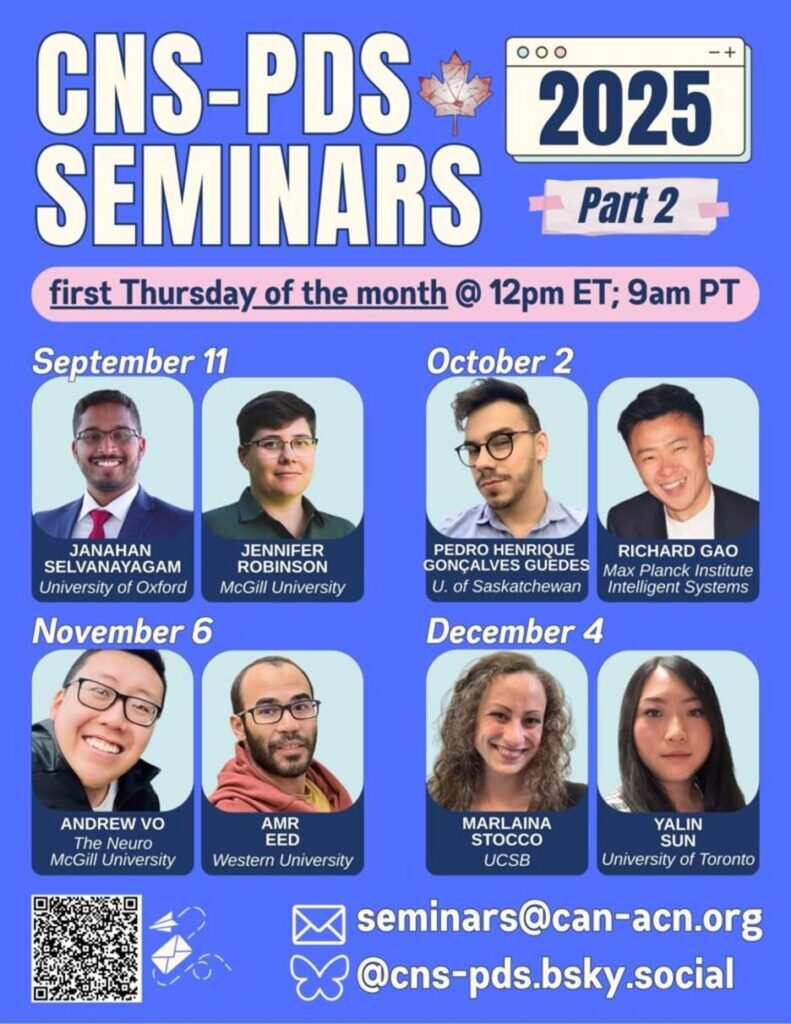
CNS-PDS Seminars: Janahan Selvanayagam & Jennifer Robinson
2025-09-11 @ 12:00 – 13:00
Announcing the return of the CAN postdoc seminar series, starting this Thursday September 11!
Register here for the first seminar series: https://us06web.zoom.us/webinar/register/2017374850028/WN_tgLb5wOvT0-E19FB-5K7rQ
SEMINAR HOST: Alessandro Zanini
SEMINAR CO-HOST: Eve Honore
SPEAKER #1
Speaker Name: Janahan Selvanayagam
Institution: University of Oxford
Abstract Title:
“Neural Representations of Abstract Cognitive Maps in Prefrontal Cortex and Medial Temporal Lobe”
SPEAKER #2
Speaker Name: Jennifer Robinson
Institution: McGill University
Abstract Title:
“Unpacking the role of the medial septum in spatial coding in the medial entorhinal cortex”
Find the exciting line up of upcoming speakers below.
Canadian neuroscience post-docs
seminars@can-acn.org
zoom
CNS-PDS October: Pedro Henrique Gonçalves Guedes & Richard Gao
2025-10-02 @ 12:00 – 2025-10-02 @ 13:00 [if 1551 not_equal=””][1551][/if 1551]
SEMINAR HOST: Mohamed Abdelhack
SEMINAR CO-HOST: Susan Coltman
SPEAKER #1
Pedro Henrique Gonçalves Guedes, University of Saskatchewan.
Title of the presentation: Development of an Optical and Colorimetric Biosensor for the Quantification of Microrna 184 for Late Life Depression.
SPEAKER #2
Richard Gao, Goethe University.
Organised by: Canadian neuroscience post-docs
Event Category: CNS-PDS
3rd Advanced Fiber Photometry Workshop – UCalgary
2025-10-21 @ 08:00 – 2025-10-24 @ 17:00 [if 1551 not_equal=””][1551][/if 1551]
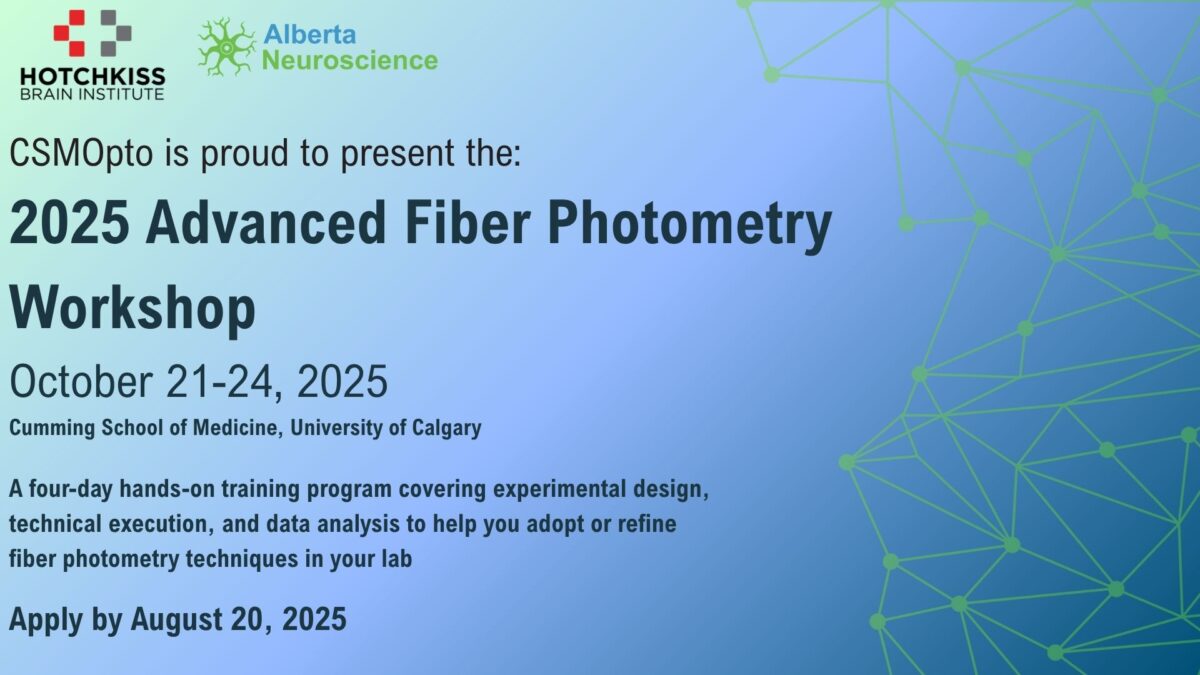
Alberta Neuroscience (ABNeuro), is proud to support the Cumming School of Medicine Optogenetics Core Facility (CSMOpto) at the University of Calgary in offering a new workshop in the technique of Fiber Photometry.
Overview
The primary goal of neuroscience is to understand how the central nervous system governs emotions and behavior. Achieving this requires detailed insight into the activity of neurons in freely behaving animals. Fiber photometry was developed precisely for this purpose—enabling researchers to monitor the activity of specific neuronal populations with high spatiotemporal resolution.
This technique is rapidly gaining popularity due to its relative simplicity and compatibility with a wide range of behavioral paradigms. However, its use remains highly variable across research groups, with no standardized protocols for implementation or data analysis, posing a challenge to reproducibility and data sharing.
To address this, the CSMOpto Advanced Fiber Photometry Workshop offers an intensive, four-day hands-on training program. The workshop is designed for members of the neuroscience research community interested in adopting or refining fiber photometry techniques within their labs. Our goal is to share our in-house expertise and resources with the broader Canadian neuroscience community to promote best practices in experimental design, technical execution, and data analysis.
Recognizing that fiber photometry is not a one-size-fits-all method, the workshop emphasizes the core principles, technical foundations, and analysis frameworks that underpin this versatile technique. Participants will gain a structured understanding that supports customization for diverse research questions while helping to build a more unified approach across labs.
The program supports open science initiatives and aligns with the mission of the Hotchkiss Brain Institute (HBI) and the Tanenbaum Open Science Institute by fostering collaboration and knowledge sharing across Alberta and Canada.
Event Category: Member submitted
CNS-PDS November: Andrew Vo & Amr Eed
2025-11-06 @ 12:00 – 2025-11-06 @ 13:00 [if 1551 not_equal=””][1551][/if 1551]
SEMINAR HOST: Prabhjot Dhami
SEMINAR CO-HOST: Alessandro Zanini
SPEAKER #1
Speaker Name: Andrew Vo
Institution: Montreal Neurological Institute; McGill University
Abstract Title:
“Convergent large-scale network and local vulnerabilities underlie brain atrophy across Parkinson’s disease stages”
SPEAKER #2
Speaker Name: Amr Eed
Institution: Western University
Abstract Title:
“MRI investigation of orientation-dependent changes in microstructure and function in a mouse model of mild traumatic brain injury”
https://us06web.zoom.us/webinar/register/2017374850028/WN_tgLb5wOvT0-E19FB-5K7rQ
Organized by: Canadian neuroscience post-docs
seminars@can-acn.org
Event Category: CNS-PDS
Neuroscience 2025
2025-11-15 @ 09:00 – 2025-11-19 @ 17:00 [if 1551 not_equal=””][1551][/if 1551]
Meet the CAN team at the SfN Meeting – We will be at booth #3732
View Organizer Website
Event Category: Partner event
CNS-PDS December: Marlaina Stocco & Yalin Sun
2025-12-04 @ 12:00 – 2025-12-04 [if 1551 not_equal=””][1551][/if 1551]
SEMINAR HOST: Darren Clarke
SEMINAR CO-HOST: Ryann Tansey
Organized by Canadian neuroscience post-docs
seminars@can-acn.org
Event Category: CNS-PDS
CNS-PDS February seminars: Mumu Aktar (U Calgary) & Earvin Tio (CAMH)
2026-02-05 @ 12:00 – 2026-02-05 @ 13:00 [if 1551 not_equal=””][1551][/if 1551]
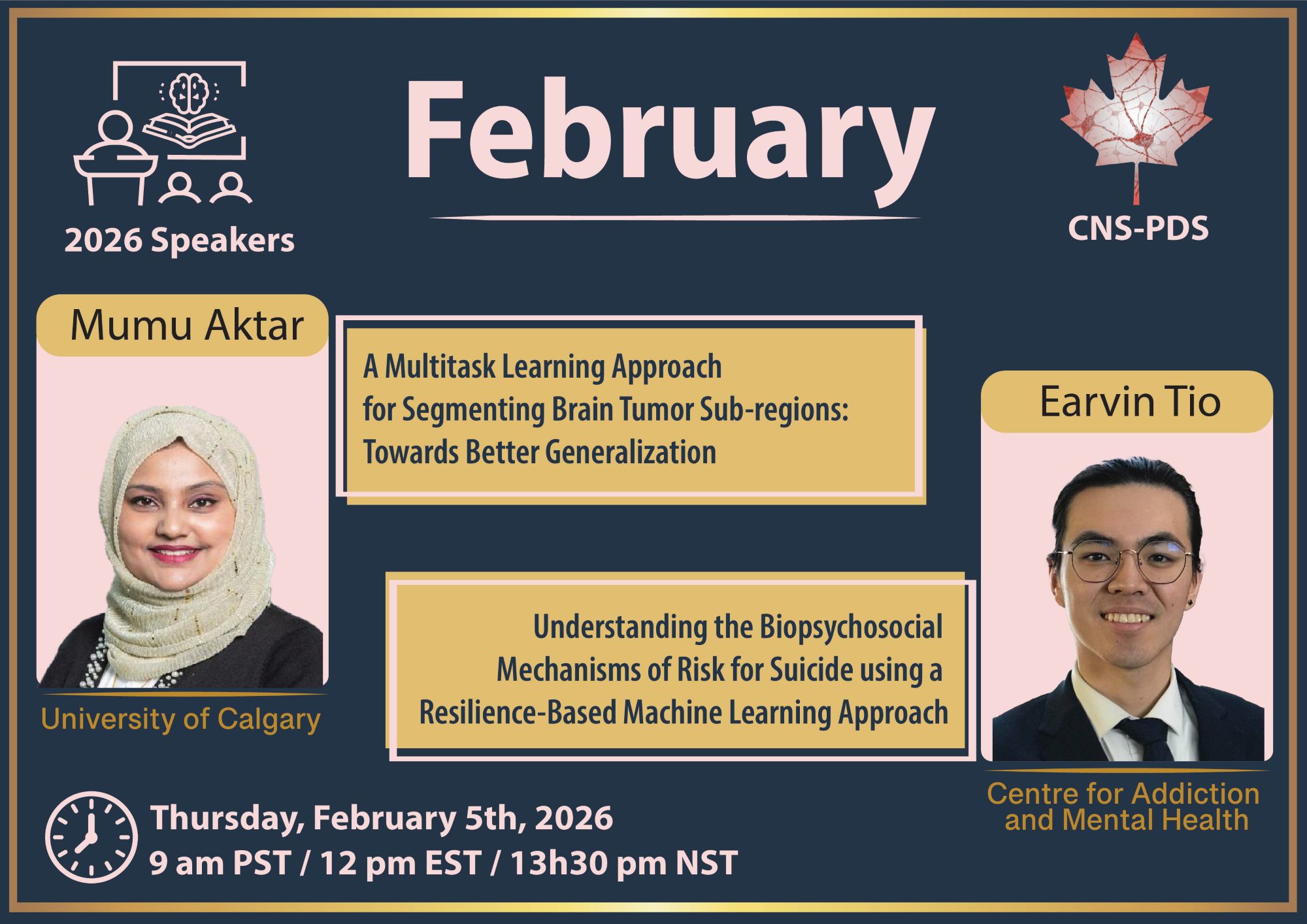
SPEAKER #1 Mumu Aktar
Institution: University of Calgary
Presentation Title: A Multitask Learning Approach for Segmenting Brain Tumor Sub-regions: Towards Better Generalization
Speaker Bio:
Mumu Aktar is a Postdoctoral Associate at the University of Calgary and holds a PhD in Computer Science from Concordia University. Her research focuses on applying artificial intelligence and large language models in the medical domain to support clinical decision-making and improve patient outcomes. She is passionate about teaching, mentoring, and developing intelligent tools that help clinicians streamline treatment workflows and save valuable time.
SPEAKER #2 Earvin Tio
Institution:
Centre for Addiction and Mental Health
Presentation Title:
Understanding the Biopsychosocial Mechanisms of Risk for Suicide using a Resilience-Based Machine Learning Approach
Speaker Bio:
Earvin S. Tio completed his PhD in Medical Science with a minor in Neuroscience at the University of Toronto under the supervision of Professor Daniel Felsky at the Centre for Addiction and Mental Health. Earvin’s research focuses on using machine learning to unravel the biopsychosocial mechanisms that underlie mental illness, particularly suicidal behaviours. He has experience working with various data modalities (e.g., clinical/tabular, multiomic, neuroimaging) from multiple sources ranging from treatment-seeking clinical populations to biobank-scale population data. Prior to his PhD, Earvin completed his BASc in Systems Design Engineering with a minor in Artificial Intelligence at the University of Waterloo, during which he held research positions at the university, at SickKids hospital, and at Sunnybrook hospital. He also studied computer science at École Polytechnique Fédérale de Lausanne.
Webinar Registration link: https://us06web.zoom.us/webinar/register/3217374850132/WN_dGwKsK1dTVOUWkh1qv8WuA
Event Category: CNS-PDS
CNS-PDS March seminars: Marieka DeVuono (Western U) & Pavel Powlowski (University of Toronto)
2026-03-05 @ 12:00 – 2026-03-05 @ 13:00 [if 1551 not_equal=””][1551][/if 1551]
Talk 1
Marieka DeVuono
Western University
Talk title: Adolescent Edible tetrahydrocannabinol (THC) Consumption Produces Sex and Dose-Dependent Neurodevelopmental Outcomes in Adulthood
Speaker Bio: Marieka DeVuono, PhD, is a Postdoctoral Associate at Western University specializing in the neuropsychopharmacology of cannabis. She earned her doctorate at the University of Guelph under Dr. Linda Parker, where she investigated cannabinoid regulation of nausea and vomiting, including the paradoxical condition, Cannabinoid Hyperemesis Syndrome. Building on this foundation, she now works with Dr. Steven Laviolette at Western University, examining the effects of cannabis exposure across the lifespan. Her current research focuses on improving the translatability of preclinical models by implementing edible cannabinoid paradigms during development. Dr. DeVuono’s work explores how adolescent exposure to cannabinoids alters neuronal development, leading to sex-specific cognitive and affective outcomes with implications for psychiatric risk and developing future harm reduction strategies.
Talk 2
Pavel Powlowski
University of Toronto
Talk title: 2-AG as a Target of Interest in Bipolar Disorder
Speaker Bio: I am a post-doctoral researcher working together with Dr. Ruth Ross and Dr. Ana Andreazza. My research centers on the role of the endocannabinoid system in bipolar disorder, using an integrative approach including genetic studies as well as functional studies in iPSC models. I am largely interested in the mechanisms underlying neuropsychiatric disorders, and GPCR signaling in health and disease.
Registration Link: https://us06web.zoom.us/webinar/register/3217374850132/WN_P5kGw6LDTT2xnWDEZM-Bcw
Event Category: CNS-PDS
CNS-PDS April seminars: Alexandre Guet McCreight (CAMH) & Theresa Wiesner (Aix-Marseille Université)
2026-04-02 @ 12:00 – 2026-04-02 @ 13:00 [if 1551 not_equal=””][1551][/if 1551]
Talk 1
Alexandre Guet McCreight
Centre for Addiction and Mental Health
Talk title: Linking age changes in human cortical microcircuits to impaired brain function and EEG biomarkers
Speaker Bio:Alexandre Guet-McCreight earned his PhD in Computational Neuroscience from the University of Toronto, under the supervision of Dr. Frances Skinner, with a focus on biophysical modeling of inhibitory hippocampal cells. After a postdoctoral period at the Krembil Brain Institute, he joined Dr. Etay Hay’s lab at the Center for Addiction and Mental Health and KCNI, where he integrates biophysical modeling and computational approaches to uncover digital biomarkers of depression, cognitive aging, and related pathologies. His research is supported by a CIHR Fellowship. More details can be found at https://agmccrei.github.io/personal_website/
Talk 2
Theresa Wiesner
Aix-Marseille Université
Talk title: Non-synaptic exocytosis along the axon shaft and its regulation by the submembrane periodic skeleton
Speaker Bio:In the early years of my bachelor’s, I got fascinated during an internship with functional assays such as field recordings to study neuronal cell behaviour. I got hooked on doing my master in Bio-photonics to learn functional imaging. During my Ph.D. in Biophotonics at Université Laval, Quebec, I combined functional assays, super-resolution imaging and computational tools to quantitatively assess and explore synaptic protein organization and remodeling due to synaptic plasticity.
My ambition is to overcome the current inability to directly link nanoscale protein organization to neuronal function, which impedes our understanding of fundamental cellular mechanisms and our capacity to alleviate misorganization in neurological disorders. Currently, I am a postdoctoral fellow in the NeuroCyto team at the Institute of NeuroPhysiopathology (INP) in Marseille, France. Here I am studying the role of actin/spectrin submembrane scaffold in axonal shaft exocytosis by combining live-cell and super-resolution microscopy.
Registration Link: https://us06web.zoom.us/webinar/register/3217374850132/WN_a1XJ1d03QOGVwfzfPqDzoA
Event Category: CNS-PDS
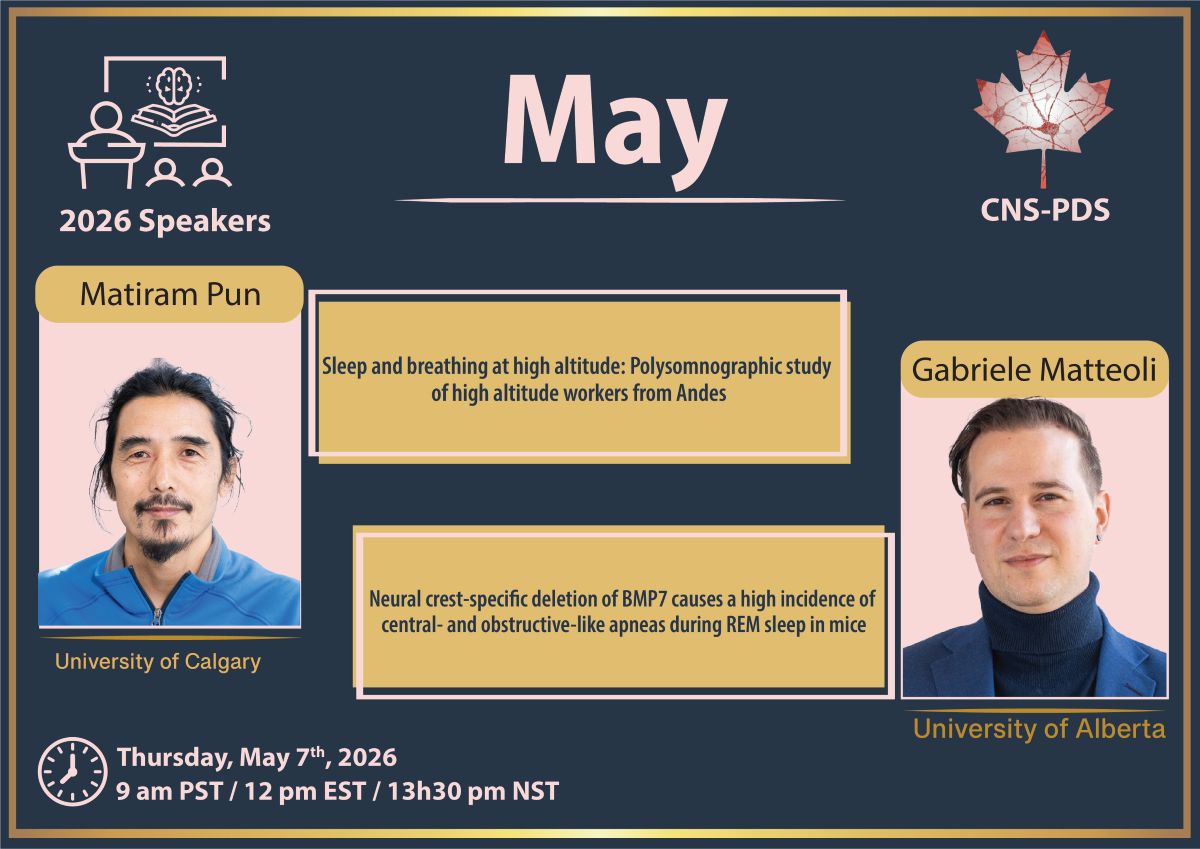
CNS-PDS May seminars: Matiram Pun (U Calgary) & Gabriele Matteoli (U Alberta)
2026-05-07 @ 12:00 – 2026-05-07 @ 13:00 [if 1551 not_equal=””][1551][/if 1551]
Talk 1
Matiram Pun
University of Calgary
Talk title: Sleep and breathing at high altitude: Polysomnographic study of high altitude workers from Andes
Speaker Bio: Matiram Pun (mati) is currently a post-doctoral scholar at the Cumming School of Medicine, University of Calgary, Calgary, Canada. Mati is from Nepal and completed his medical training (MBBS 2007) in Nepal. Mati completed MSc (2013) and PhD (2025) in Mountain Medicine and High Altitude Physiology from the University of Calgary. Mati has been working in high altitude illness right from his medical school. Mati focused his masters in sleep-disordered breathing, primarily obstructive sleep apnea (OSA), with intermittent hypoxia (IH) in a controlled laboratory environment in Calgary. Then Mati worked sleep architectures (macro and micro), OSA, IH, ventilation and cognition during his PhD. Mati studied OSA patients, aging population and high altitude workers for his PhD desertation. Mati studied high altitude shift workers at The Atacama Large Millimeter/submillimeter Array (ALMA) in northern Chile. Some of Mati’s previous research involved studying the effects of acute, subacute, and chronic exposure to very high altitudes in the Nepal Himalayas and South American Andes.
Talk 2
Gabriele Matteoli
University of Alberta
Talk title: Neural crest-specific deletion of BMP7 causes a high incidence of central- and obstructive-like apneas during REM sleep in mice
Speaker Bio:I completed my Master’s degree (2019) and PhD (2024) at the University of Bologna (Italy), where I investigated how sleep influences respiratory and cardiovascular function in mouse models of human disease (Narcolepsy Type 1, autoimmune Anti-IgLON5 disease, and perinatal exposure to nicotine, cotinine, and pesticides). During my PhD, we developed a method to distinguish central-like and obstructive-like sleep apneas in mice by analyzing sleep-wake states, breathing pattern, and diaphragm activity. This technique has been successfully applied to mouse models of Down syndrome and CDKL5 Deficiency Disorder. In 2024, I joined the University of Alberta as a Postdoctoral Fellow to study the neural control of breathing using viral tools to modulate preBötzinger complex activity. Since May 2025, as a Women and Children’s Health Research Institute Postdoctoral Fellow, my research has focused on how perinatal exposure to cannabinoids affects sleep and breathing in newborn rats and maternal behavior.
Registration Link
Event Category: CNS-PDS
CANGlia 2026 Meeting
2026-05-14 @ 19:00 – 2026-05-16 @ 21:00 [if 1551 not_equal=””][1551][/if 1551]
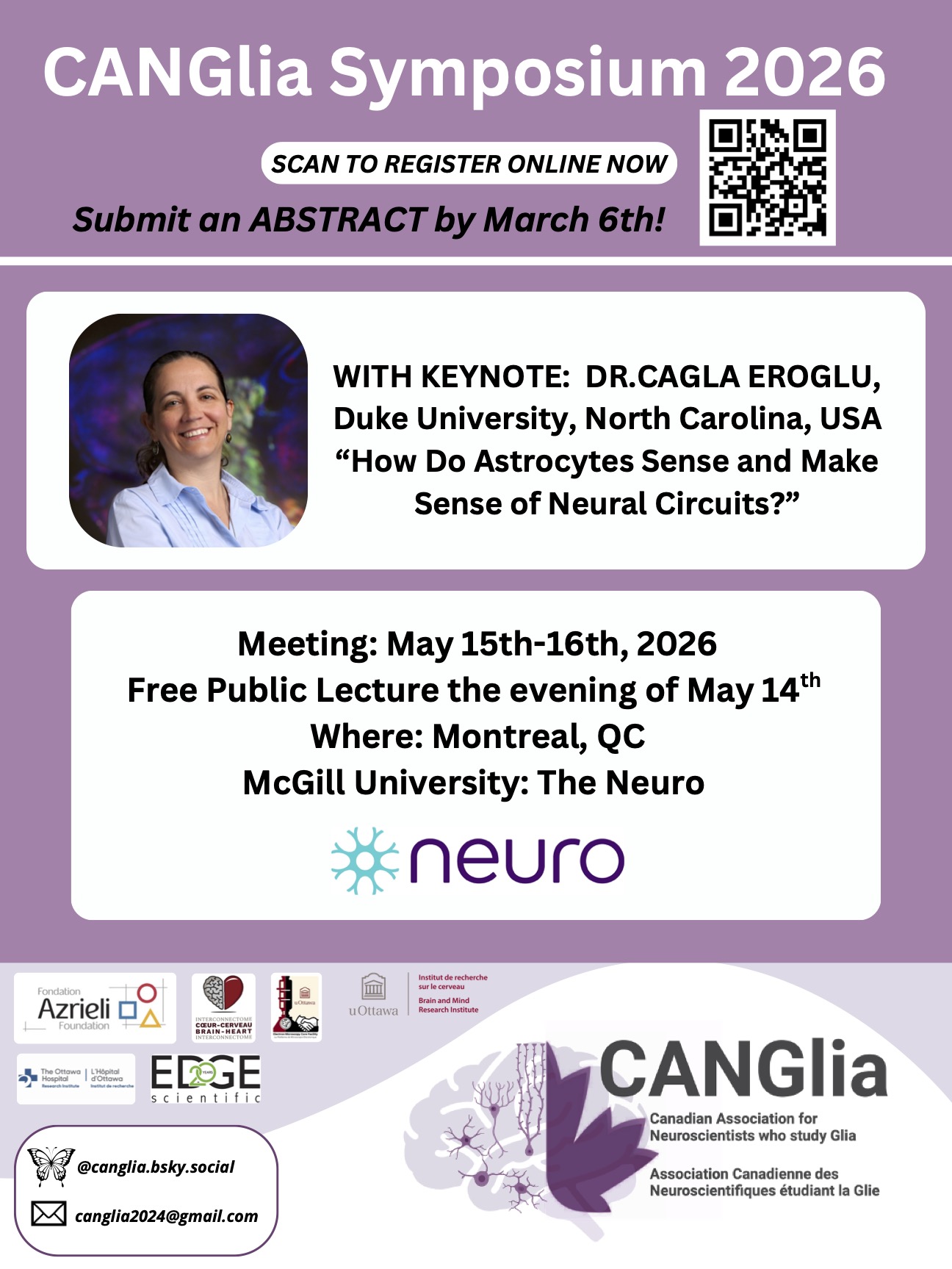
The Canadian Association for Neuroscientists who study Glia (CANGlia) is proud to present our third annual meeting, bringing together leading researchers and emerging talent in glial science from across Canada. Glial science is often a small portion of larger neuroscience meetings and few, if any, annual specialized meetings for glial science exist in Canada. As such, in 2024 we started the CANGlia with an inaugural meeting featuring researchers and trainees at all levels of study, diverse representation and exciting glial science. The success of this event, along with community feedback that indicated excitement for continued events has led us to host a second full-day event on May 20th, 2025 in Toronto. We are committed to bring diverse Canadian glial scientists together from across the country and at all levels of training and as such we are currently organizing our third annual meeting which will now feature two-days of glial science from May 15th-16th 2026! More details can be found on our website and Registration is now open!
Event Category: Member submitted
Women in Learning Luncheon at CAN
2026-05-20 @ 12:00 – 2026-05-20 @ 14:00 [if 1551 not_equal=””][1551][/if 1551]
Event Category: Member submitted
IBRO – NCAMH Special Interest Event: Building Capacity and Community in Global Neuroscience
2026-05-20 @ 19:00 – 2026-05-20 @ 20:00 [if 1551 not_equal=””][1551][/if 1551]
Organiser: International Brain Research Organization (IBRO)
Funder: Wellcome
Date & Time: Wednesday, 20 May 2026; 19:00 – 20:00
Location: Room Montreal 6-7-8 @ Bonaventure Hotel
This Special Interest Event (SiE) is organized within the framework of the Neuroscience Capacity Accelerator for Mental Health (NCAMH), an innovative program supporting neuroscience research capacity in Low- and Middle-Income Countries (LMICs). Following the scheduled EDI session, the event aims to elevate lived experience perspectives in mental health research and highlight the value of international collaboration.
Speakers
- Emma Byrne, PhD | Robot Scientist, Neuroscience Author
- Andreea Dioconescu, PhD | NCAMH Project Collaborator
- Julie Lefebvre, PhD | Former NCAMH Scientific Advisory Board Member
Event Category: Partner event