
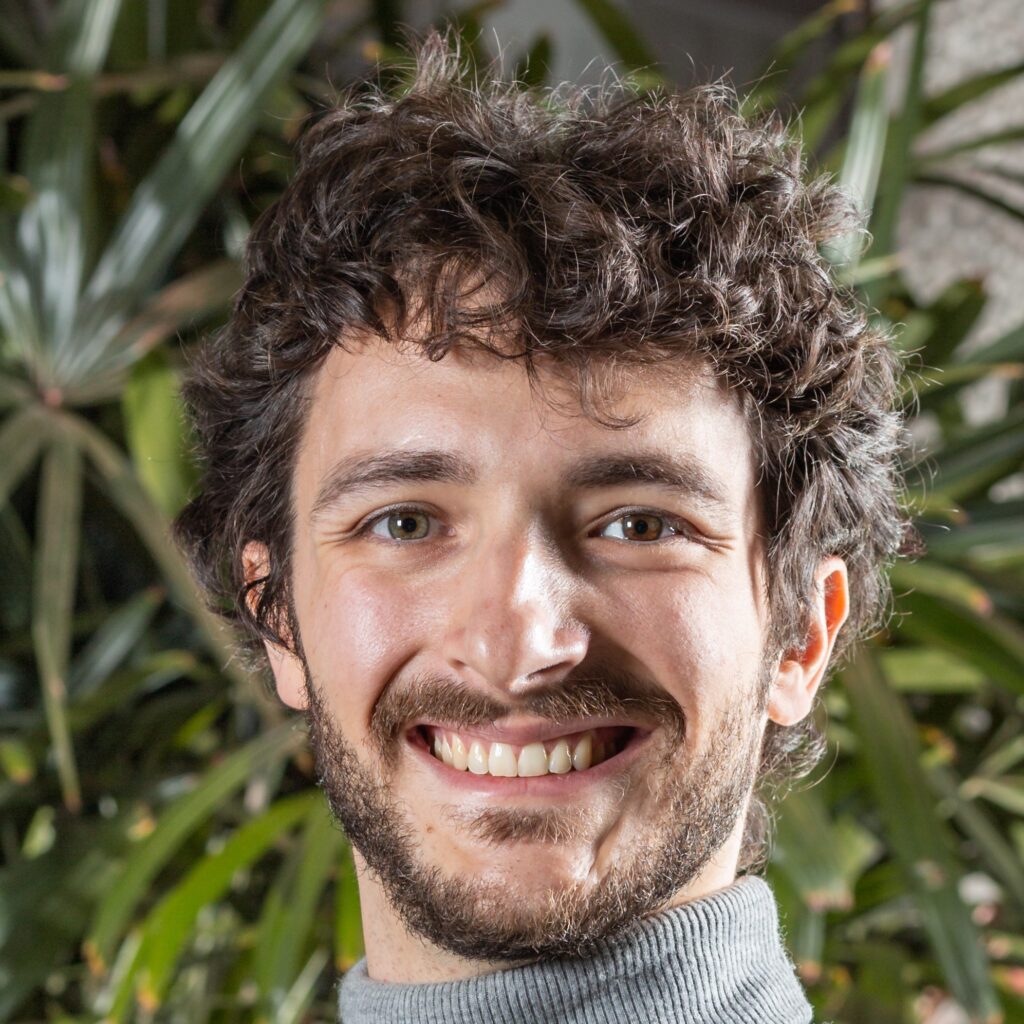
Dr. Andrea Luppi
Work done at McGill University
Article citation
Andrea I. Luppi, Zhen-Qi Liu, Justine Y. Hansen, Rodrigo Cofre, Meiqi Niu, Elena Kuzmin Seán Froudist-Walsh, Nicola Palomero-Gallagher, and Bratislav Misic. Benchmarking macaque brain gene expression for horizontal and vertical translation. Science Advances, 11(9), eads6967 (2025). DOI: 10.1126/sciadv.ads6967
Lost in translation: how gene expression diverges between humans and macaque model systems
Among all model organisms studied in neuroscience, the macaque is genetically closest to humans. Genetic similarity is paramount because genes exert powerful influences on brain organization, function, and dysfunction. But the potential for research to find applications in the clinic, that is its translational value, rests on the untested assumption that gene expression in the macaque follows the same organisation as human genes. Work by Andrea Luppi, working in the laboratory of Bratislav Misic at the Montreal Neurological Institute, provides the first systematic benchmarking of macaque gene expression in the cerebral cortex to investigate how similar, or different, brain expression is in the two species.
The researchers found that the translational potential of macaque gene expression exhibits profound variation across genes, across brain regions, and across layers of the cortex. Only about 50% of brain-related genes follow similar patterns in human and macaque cortex. Crucially, this heterogeneity is not random: they discovered systematic patterns. Inter-species correspondence of gene expression is stronger in evolutionarily older sensory/motor regions, but weaker in higher-order areas, mirroring the expansion of the cortex in humans relative to the macaque.
In this study, the researchers integrated, harmonised, and openly shared the largest available databases of macaque cortical gene expression and cell type composition from spatial transcriptomics, recently published by researchers from the Chinese Academy of Sciences, and the largest available database of autoradiography for 13 different types of macaque brain receptors, previously published by Seán Froudist-Walsh and Nicola Palomero-Gallagher, both co-authors of the present study. They validated results against the Allen Human Brain Atlas database of human gene expression, but also with advanced experimental techniques to investigate gene expression in humans and macaques.
This work addressed fundamental questions on the genetic foundations of brain organisation, with broad implications for translational neuroscience studies and their clinical and non-clinical applications. Over 90% of drugs for psychiatric conditions that seem promising when tested on model organisms eventually fail in humans and are ‘lost in translation’.
Up to this point we lacked systematic knowledge of which genes follow the same organization in macaque and human brains, and which genes instead have diverged – which could drastically change how they influence brain function, and whether they provide suitable targets for pharmacological intervention.
The finding that only about 50% of brain-related genes follow similar patterns in human and macaque cortex, reveals that the prevailing assumption of a close inter-species correspondence may be misleading. Instead, the rich resource that the researchers shared provides a guide to which brain systems and genes are most (or least) suitable for cross-species translational studies. Indeed, they found that evolutionary divergence across cortical areas affects how well macaque data translate to human biology. Looking forward, this resource enables the development of computational models that include species-specific biology.
About Andrea Luppi
Dr Andrea Luppi is a Wellcome Early Career Fellow at the University of Oxford, and Fellow of St John’s College Cambridge. Prior to his current position he was a Molson Neuro-Engineering Fellow and then Banting Fellow at the Montreal Neurological Institute of McGill University, and he obtained his PhD in neuroscience from the University of Cambridge after degrees in psychology, philosophy, and neuroscience. His work investigates how brain function and consciousness arise from the complex interplay of brain architecture and dynamics. To this end, he combines approaches from information theory, network science and whole-brain computational modelling to investigate pharmacological and pathological perturbations of brain function in humans and other species.
Source of funding
A.I.L. was funded by a Banting Postdoctoral Fellowship of the Government of Canada (Natural Sciences and Engineering Research Council of Canada (NSERC) funding reference number 202209BPF-489453-401636), a UNIQUE Neuro-AI Excellence Award of the Centre UNIQUE – Union Neuroscience & Artificial Intelligence – Quebec (Fonds de Recherche du Québec – Nature et Technologies (FRQNT) Strategic Clusters Program 2020-RS4–265502) and a Wellcome Early Career Award (grant number 226924/Z/23/Z). B.M. acknowledges support from the NSERC, Canadian Institutes of Health Research (CIHR), Brain Canada Foundation Future Leaders Fund, the Canada Research Chairs Program, the Michael J. Fox Foundation, and the Healthy Brains for Healthy Lives initiative. Z.-Q.L. acknowledges support from the FRQNT. N.P.-G. acknowledges the support of the Deutsche Forschungsgemeinschaft (PA 1815/1–1) and the Helmholtz Association’s Initiative and Networking Fund through the Helmholtz International BigBrain Analytics and Learning Laboratory (HIBALL) under the Helmholtz International Lab (grant agreement InterLabs-0015). S.F.-W. acknowledges the support of UKRI Biotechnology and Biological Sciences Research Council (BBSRC, UK) grant BB/X013243/1. Any opinions, findings, and conclusions or recommendations expressed in this material are those of the authors and do not reflect the views of the funders.