
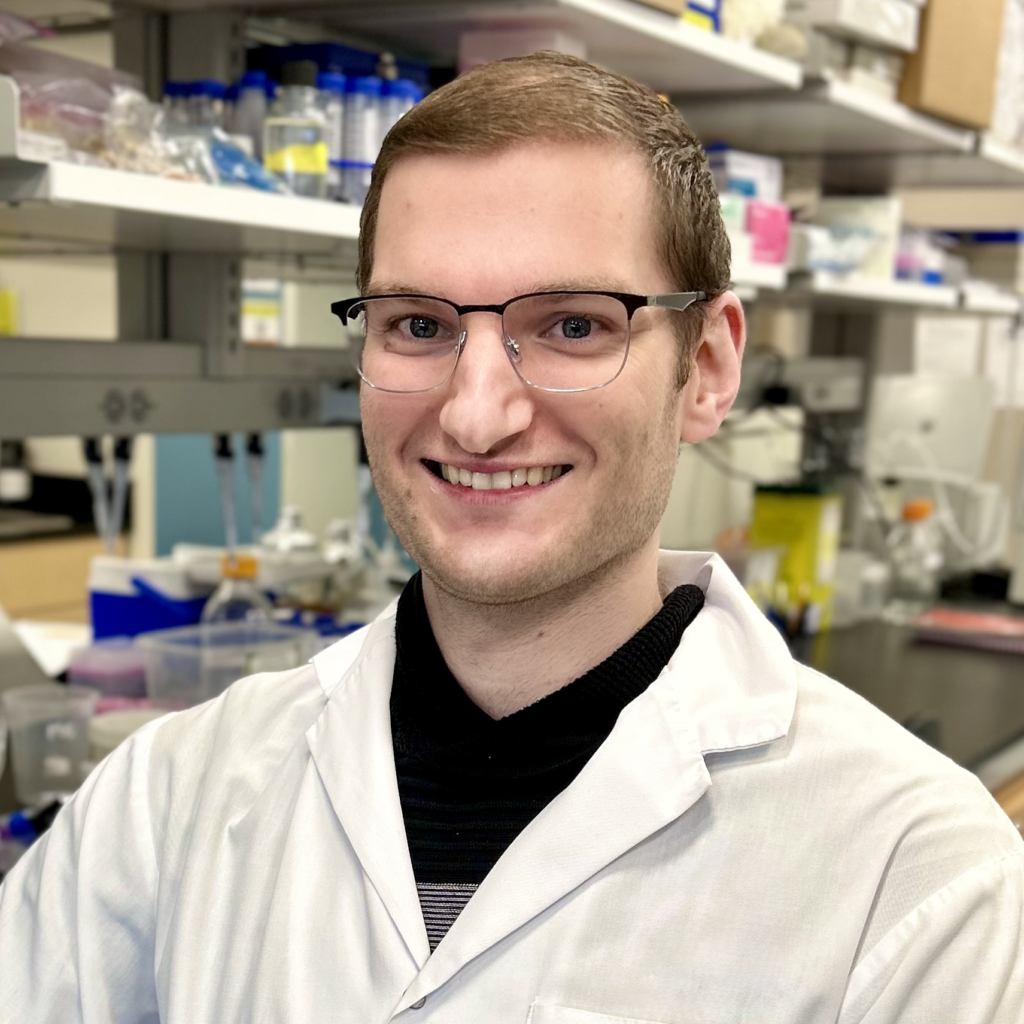
Dr. Terry Suk
Work done at University of Ottawa
Article citation
Suk, T.R., Part, C.E., Nguyen, T.T., Zhang, J.L., Heer, M.M., Caballero-Gómez, A., Grybas, V.S., McKeever, P.M., Nguyen, B., Ali, T., Callaghan, S.M., Woulfe, J.M., Robertson, J., and Rousseaux, M.W.C. A stress-dependent TDP-43 SUMOylation program preserves neuronal function. (2025) – Molecular Neurodegeneration 20 (38). DOI:
Stress-dependent modification of a protein called TDP-43 helps neurons recover once the stress has passed
Many neurodegenerative diseases, including Amyotrophic Lateral Sclerosis (ALS) and Frontotemporal Dementia (FTD), are linked to improper function of a protein called TDP-43. Under healthy conditions, TDP-43 is found inside the nucleus of neurons, where it plays critical roles in maintaining neuronal health. In disease however, TDP-43 leaves the nucleus and forms toxic aggregates, a key pathological feature of both ALS and FTD. Aging and other cellular stresses are thought to contribute to this process, but the mechanisms that protect TDP-43 have remained unclear.
In this study, Terry Suk, working in the laboratory of Maxime Rousseaux at the University of Ottawa, discovered that when cells experience stress, TDP-43 undergoes a protective chemical modification called SUMOylation which helps the cell recover once the stress has passed. When the researchers prevented this process in mice, neurons became more vulnerable to aging, leading to sex-specific symptoms mimicking ALS and FTD. They further found that in the brains of humans diagnosed with ALS or FTD, the TDP-43 SUMOylation pathway is activated, suggesting that neurons actively attempt to protect TDP-43 during disease. Together, these findings reveal a natural protective mechanism that helps maintain TDP-43 function during aging. Understanding how this process fails during human aging may open new avenues for preventing or treating neurodegenerative diseases.
Although rare mutations in TDP-43 can cause amyotrophic lateral sclerosis (ALS) and frontotemporal dementia (FTD), most patients do not carry genetic mutations yet still develop TDP-43 pathology. This disconnect has long suggested that non-genetic factors, such as cellular stress associated with aging, play a central role in driving TDP-43 dysfunction. However, the molecular mechanisms by which stress influences TDP-43 behavior had remained poorly understood. This work establishes SUMOylation as a protective, stress-responsive modification of TDP-43 that helps preserve its normal function. Importantly, within a few months of publication, three independent research groups worldwide reported convergent findings, collectively reinforcing the conclusion that TDP-43 SUMOylation represents a conserved protective response to stress. This rapid independent replication underscores the robustness and broad relevance of the mechanism. Additionally, a major impact of this study is the development of a novel mouse model in which SUMOylation of endogenous TDP-43 is selectively disrupted. Unlike traditional models that rely on artificial expression or rare disease-causing mutations, this system develops pathology in an age- and sex-dependent manner driven by natural age-associated cellular stress. As a result, it more closely mirrors human disease biology and captures physiologically relevant variability observed in patients. This model provides a powerful new platform to study how aging and stress interact to promote neurodegeneration and for testing therapeutic strategies. Finally, by demonstrating activation of the TDP-43 SUMOylation pathway in human ALS and FTD brain tissue, this work directly links the mechanism to human disease, highlighting its translational relevance.
About Terry Suk
Dr. Terry Suk completed his PhD at the University of Ottawa under the supervision of Dr. Maxime Rousseaux, where he led the collaborative study identifying stress-dependent SUMOylation of TDP-43 as a protective mechanism in neurodegeneration. He is currently a postdoctoral scholar at Northwestern University in Chicago under the supervision of Dr. David Gate. His research focuses on how genetic and molecular factors contribute to selective neuronal vulnerability in neurodegenerative diseases, including ALS and FTD.
Sources of funding
Project Funding:
- ALS Society of Canada/Brain Canada Foundation – Discovery Grant Program
- Canadian Institute of Health Research – Project Grant
- NSERC Discovery Grant and Discovery Launch Supplement
- Canada Research Chairs Program
- James Hunter and Family ALS Initiative
Trainee Funding:
- ALS Society of Canada/Brain Canada Foundation – Trainee Award Program
- Eric Poulin Center for Neuromuscular Disease – Student Translational Research Awards
- Canadian Institute of Health Research – Canadian Graduate Scholarship Awards
- Ontario Graduate Scholarship Program
- University of Ottawa – Medical Student Summer Research Program Award
- NSERC – Undergraduate Research Award
- Brain Canada Foundation – Rising Star in ALS Research Award in memory of Madeleine Blanc
- Christopher Chiu Senior Postdoctoral Fellowship